
If you have spent years hearing the term PCOS, you may soon start seeing another name in doctors’ offices, medical reports and health information: PMOS.
In May 2026, an international group of patient and professional organisations formally announced Polyendocrine Metabolic Ovarian Syndrome (PMOS) as the new name for the condition previously known as Polycystic Ovary Syndrome (PCOS).
The change followed a 14-year international process involving more than 50 patient and professional organisations and over 22,000 survey responses. The Endocrine Society says the condition affects about one in eight women worldwide—more than 170 million people.
Bangladesh is already beginning to use the new terminology. On September 5, the Bangladesh Endocrine Society brought endocrinologists, gynaecologists, reproductive-health specialists and other physicians together in Dhaka for a scientific workshop on PMOS diagnosis and management as part of PMOS Awareness Month.
Why was PCOS renamed?
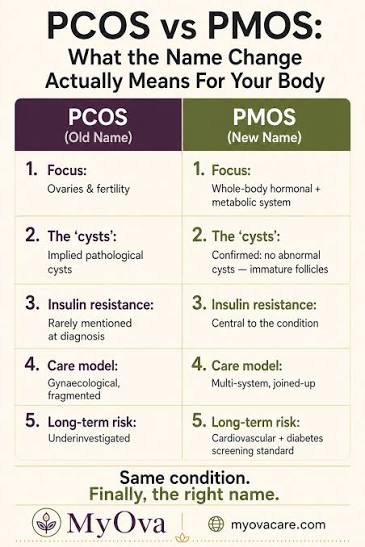
The biggest problem with the old name was the word “polycystic.”
Despite the name, PCOS was never simply a disease of ovarian cysts. Experts involved in the renaming process say there is not actually an increase in abnormal ovarian cysts in people with the condition.
Instead, it is a complex hormonal disorder that can affect ovulation, metabolism, skin, reproductive health and psychological wellbeing.
That is why the new name begins with “Polyendocrine Metabolic”—putting hormonal and metabolic effects at the centre rather than focusing almost entirely on the ovaries.
Does this mean your PCOS diagnosis is no longer valid?
No.
PCOS and PMOS refer to the same underlying condition. A person previously diagnosed with PCOS does not suddenly need a new diagnosis simply because the terminology has changed.
The change will also happen gradually. International organisations have planned a three-year transition period, with the new name expected to be fully incorporated into the next international guideline update in 2028. During this period, patients may encounter both PCOS and PMOS in health information and clinical practice.
What symptoms can PMOS cause?
The condition does not look the same in every woman.
Possible features include:
irregular, infrequent or absent menstrual periods;
problems with ovulation;
increased facial or body hair;
acne or oily skin;
thinning hair on the scalp;
difficulty becoming pregnant because of irregular ovulation; and
metabolic problems such as insulin resistance or increased risk of type 2 diabetes.
Importantly, not everyone with PMOS is overweight, and not everyone has the same symptoms.
International guidelines also emphasise that PMOS can be associated with sleep problems and higher rates of anxiety and depression, making it important to look beyond periods and fertility alone.
Do you need ovarian cysts to be diagnosed?
No—and this is one of the misconceptions the name change is intended to correct.
For adults, current international guidelines generally require two of three major features after other possible causes have been excluded: evidence of excess androgen activity, problems with ovulation, or polycystic ovarian morphology on ultrasound or an appropriate AMH assessment.
If an adult already has both irregular menstrual cycles and evidence of excess androgen activity, the international guideline says an ovarian ultrasound is not necessarily required to establish the diagnosis. Diagnosis is different in adolescents, where greater caution is required.
That is why symptoms should be assessed by a qualified healthcare professional rather than relying on an ultrasound report alone.
What about fertility?
PMOS can make pregnancy more difficult for some women because it can interfere with regular ovulation. But having PMOS does not mean a woman cannot become pregnant.
Fertility is only one part of the condition. Modern guidelines encourage healthcare providers to consider reproductive health alongside metabolic health, emotional wellbeing and longer-term health risks.
Treatment therefore depends on the individual woman—her symptoms, health risks and whether she is currently trying to conceive.
When should you speak to a doctor?
Consider discussing your symptoms with a gynaecologist, endocrinologist or appropriately trained physician if you have persistently irregular or absent periods, significant new facial or body hair growth, severe acne, difficulty becoming pregnant, or a previous PCOS diagnosis but have not had your longer-term metabolic health reviewed.
Women already diagnosed with PCOS should not stop medicines or change treatment simply because the condition has been renamed.
The most important message from the shift from PCOS to PMOS may be surprisingly simple:
This was never only about the ovaries.
For years, the term PCOS encouraged many women to think of the condition primarily as a period, fertility or “ovarian cyst” problem. The new name is an attempt to recognise something medicine has increasingly understood: PMOS can involve hormonal, reproductive and metabolic health across different stages of a woman’s life.
And better understanding may be the first step toward better care.




Join the discussion